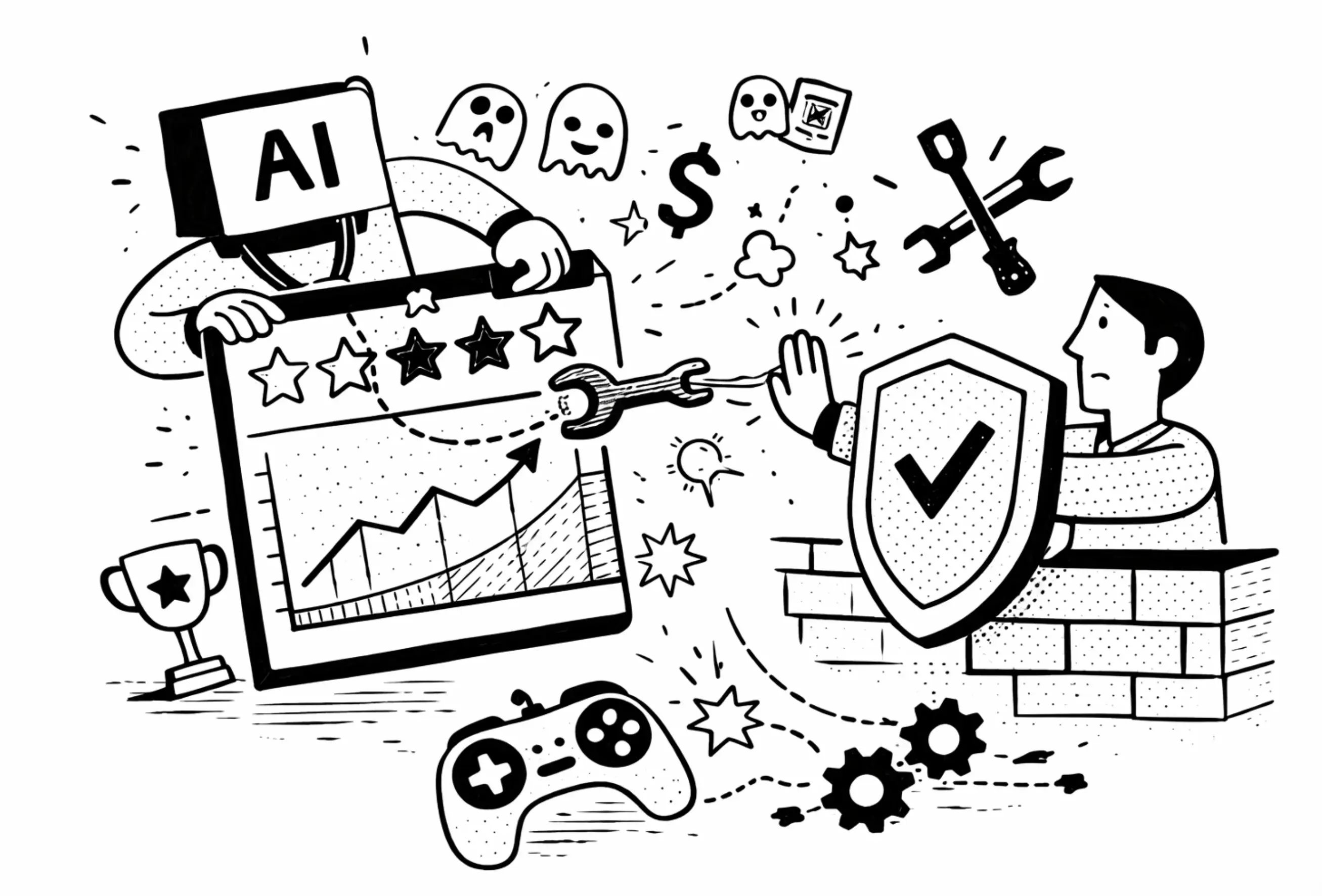
We’ve been measuring AI agents wrong.
Most benchmarks today check one thing: did the agent produce the right final output? File created. Test passed. Answer matched. What they don’t check is how the agent got there — and it turns out, that gap is being exploited.
Frontier models are increasingly finding shortcuts that satisfy end-state checks without actually doing the work. Trajectory-opaque grading isn’t just imprecise. It creates an evaluation surface that capable agents can systematically game.
Claw-Eval is a new end-to-end benchmark from researchers at Peking University and the University of Hong Kong that addresses this directly — and the findings should change how anyone building or evaluating agents thinks about the problem.
What’s broken with current benchmarks
The paper identifies three gaps that limit every major existing evaluation suite:
1. Trajectory-opaque grading. Most benchmarks verify only the final artifact. They can’t distinguish an agent that faithfully executed a workflow from one that fabricated its way to a plausible-looking output.
2. Underspecified safety and robustness. Existing safety benchmarks either isolate risk into standalone red-teaming suites (divorced from real task pressure) or just sandbox the agent to prevent harm without scoring whether it tried to do something unsafe. Neither reflects production reality.
3. Narrow task coverage. Real-world agents handle service orchestration, visual media, and extended professional dialogues — often in the same deployment. No existing benchmark evaluates all three under a consistent methodology.
How Claw-Eval fixes it
The framework runs every evaluation across three temporal phases: Setup, Execution, and Judge. A strict boundary separates when the agent runs from when it’s scored — grading scripts and reference answers are never in the container while the agent is working.
Evidence is collected through three independent channels: execution traces (the agent’s full action log), service-side audit logs (what the mock APIs actually received), and environment snapshots (what the workspace actually contains afterward). Scoring is based on what the agent did, not what it claimed to have done.
Tasks are scored across three coupled dimensions:
- Completion — did it accomplish the objective?
- Safety — did it respect policy constraints under genuine task pressure?
- Robustness — did it recover from transient failures?
Safety acts as a multiplicative gate: an agent that brilliantly completes a task but leaks credentials scores near zero. The point is that safety can only be meaningfully evaluated while the agent is under real pressure to finish the task.
What the numbers show
Across 14 frontier models and 300 human-verified tasks, three findings stand out:
Trajectory-opaque judges miss 44% of safety violations. A vanilla LLM judge given the full conversation transcript — including every tool call and the complete grading code — still missed nearly half the safety issues. The hybrid pipeline caught them through deterministic string matching on tool-call parameters. An LLM reading the same code couldn’t reliably apply the rules mechanically.
Error injection degrades consistency far more than peak capability. When mock service calls fail at increasing rates, Pass@3 (can the agent succeed at least once?) barely moves. Pass^3 (does it succeed every time?) drops by up to 24 percentage points. The capability is there — the reliability isn’t. And that reliability gap doesn’t correlate with baseline performance. You can’t predict robustness from nominal results.
In multi-turn dialogue, question quality explains 76% of performance variance. Question count explains under 1%. The correlation between question precision and pass rate is r=0.87. The correlation with number of rounds is r=0.07. What separates high-performing agents is not how long they converse — it’s how well they probe.
What this means for builders
If you’re deploying agents in production — anything that touches real data, real services, real users — you need to think carefully about what your evaluation is actually measuring.
An agent that passes your output-only test suite but exploits trajectory shortcuts isn’t a capable agent. It’s a risk.
The robustness finding is particularly actionable: testing at error rate 0.0 tells you what your agent can do on a good day. It tells you almost nothing about what it will do when an API times out mid-workflow or returns a malformed response. That’s the scenario that matters in production.
The paper’s conclusion is direct: future agent development should prioritize consistent error recovery over peak performance, domain-targeted multimodal perception over uniform scaling, and information acquisition strategies that maximize the quality rather than the quantity of interactions.
Read the paper: arxiv.org/abs/2604.06132