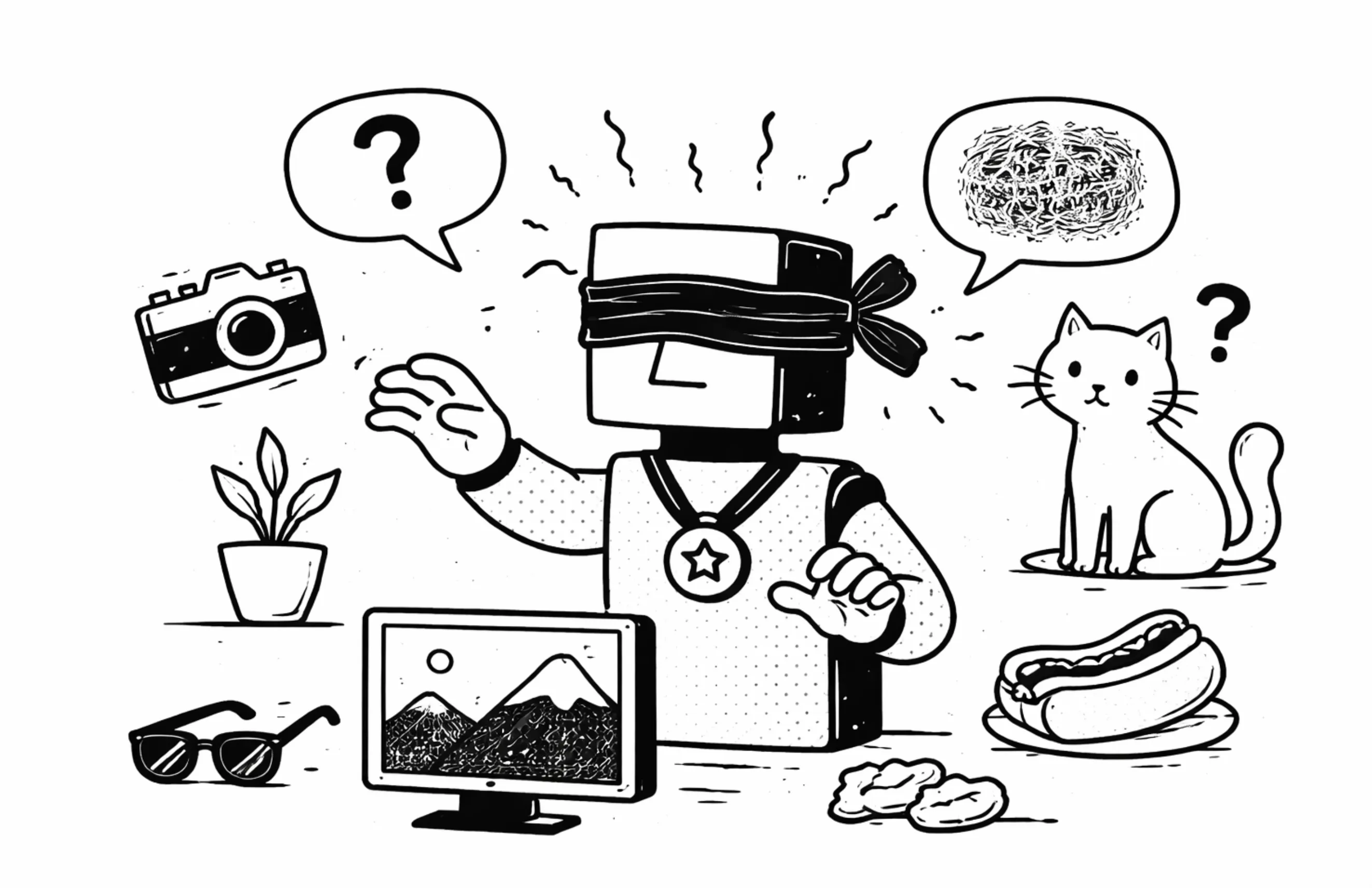
There’s a counterintuitive idea buried in a new paper out of CVPRW: Vision-Language Models (VLMs) sometimes perform worse when you give them better images.
The paper introduces Degradation-Driven Prompting (DDP) — a framework that intentionally reduces image quality before feeding it to a model. The result? Better answers on Visual Question Answering (VQA) benchmarks, particularly on tasks involving physical attributes, optical illusions, and perceptual phenomena.
Why does this work?
High-resolution images carry a lot of texture, color, and fine-grained detail. For some reasoning tasks, that detail is noise — it pulls the model’s attention away from the structural information that actually matters. By downsampling to 80%, applying blur masks, contrast enhancement, and structural overlays (like white background masks and orthometric lines), DDP forces the model to focus on shape and structure rather than surface appearance.
It’s the visual equivalent of squinting at something to see it better.
What they tested
- Physical attributes — questions where human intuition often misfires (weight, size, material). DDP + in-context learning significantly improved accuracy.
- Perceptual illusions — visual anomalies, color illusions, motion illusions, Gestalt effects, geometric illusions. These reliably fool standard VLMs. DDP helped models cut through them.
The framework applies a task-classification stage first, then routes each image to a specialized degradation pipeline — blur masks for illusions, downsampling + structural aids for physical reasoning. It’s not one-size-fits-all; it’s targeted noise removal.
The production takeaway
If you’re building vision-based AI systems, image preprocessing is not just a performance optimization — it’s a reasoning strategy. The right degradation, applied strategically, can be the difference between a model that hallucinates and one that reasons correctly.
Less detail. Better answers.
Read the paper: arxiv.org/abs/2604.04838