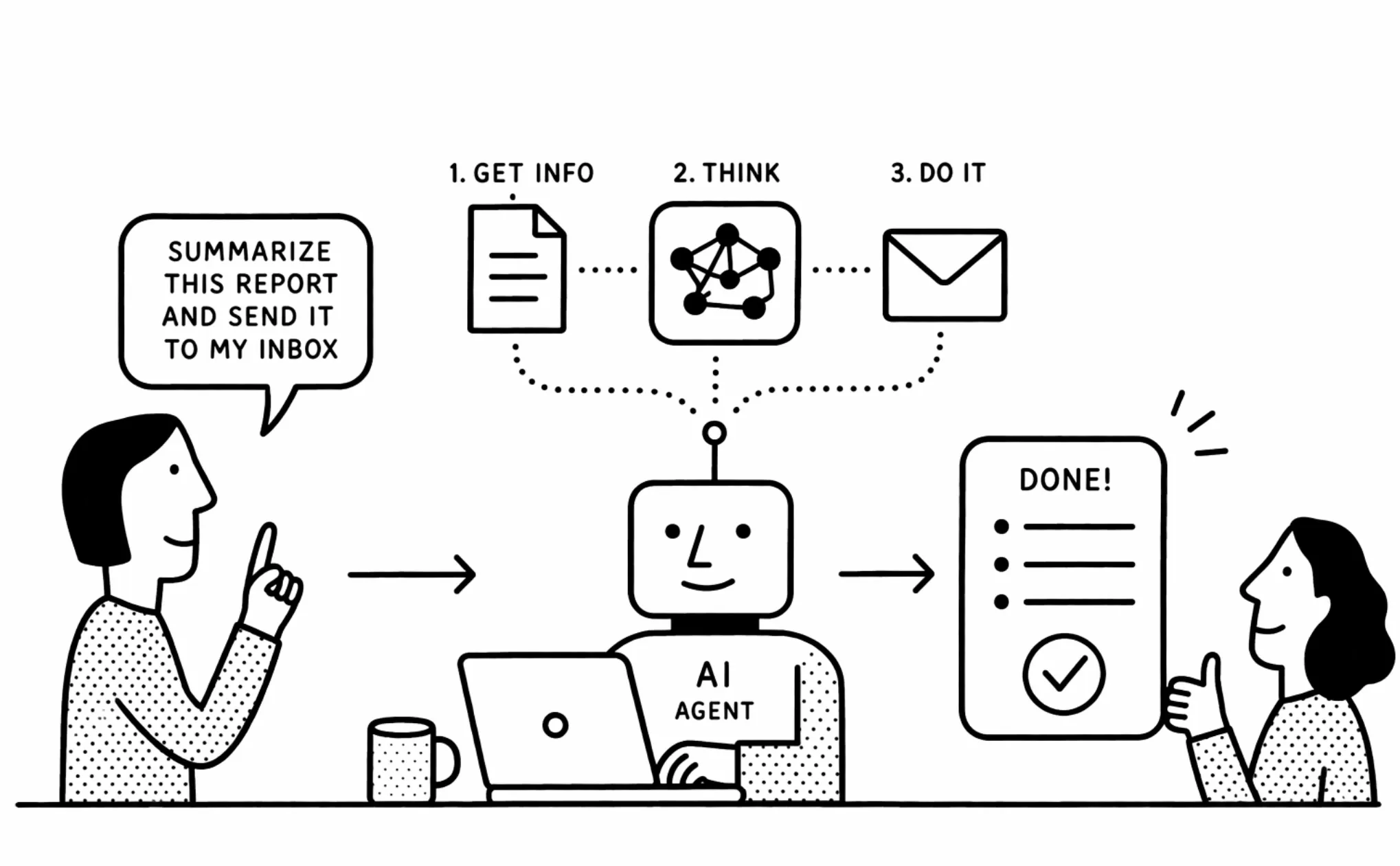
There’s a trend in AI agent development toward complexity. Multi-step orchestration frameworks. Browser-controlling agents that click through UIs. MCP servers that abstract everything. The assumption is that more sophisticated architecture means better results.
A new paper argues the opposite — and backs it up with data.
“Terminal Agents Suffice for Enterprise Automation” makes a simple, almost provocative claim: a coding agent with nothing but a terminal and a filesystem can match or outperform all of those complex architectures for real enterprise tasks.
The argument
Most enterprise platforms expose APIs. Those APIs are more reliable, faster, and more expressive than any UI. So why are we building agents that navigate GUIs like a person would, when they could just call the API directly?
The researchers tested terminal-only agents across a wide range of real-world enterprise systems — the kind of tasks businesses actually need automated. The terminal agent, writing and executing code against platform APIs, matched or beat more complex agent setups in nearly every case.
No browser automation. No MCP abstraction layer. Just a model, a shell, and an API.
Why complexity loses
Complex agent architectures have real costs:
- Operational overhead — more moving parts means more things to break
- Latency — every abstraction layer adds round-trips
- Fragility — GUI-based agents break when the UI changes; API calls don’t
- Cost — orchestration frameworks burn tokens on coordination
The terminal agent sidesteps all of this. It’s not glamorous, but it works.
The takeaway for builders
This isn’t an argument against all agent complexity — some tasks genuinely require it. But it’s a useful corrective to the instinct to reach for the most sophisticated tool available.
Before you wire up a 5-step agentic pipeline, ask: could a script do this? Could a single agent with API access handle it? In most enterprise automation scenarios, the answer is yes.
The best automation is often the simplest one that actually ships and runs reliably in production. Complexity is a cost. Make sure you’re getting something in return for it.
Read the paper: arxiv.org/abs/2604.00073