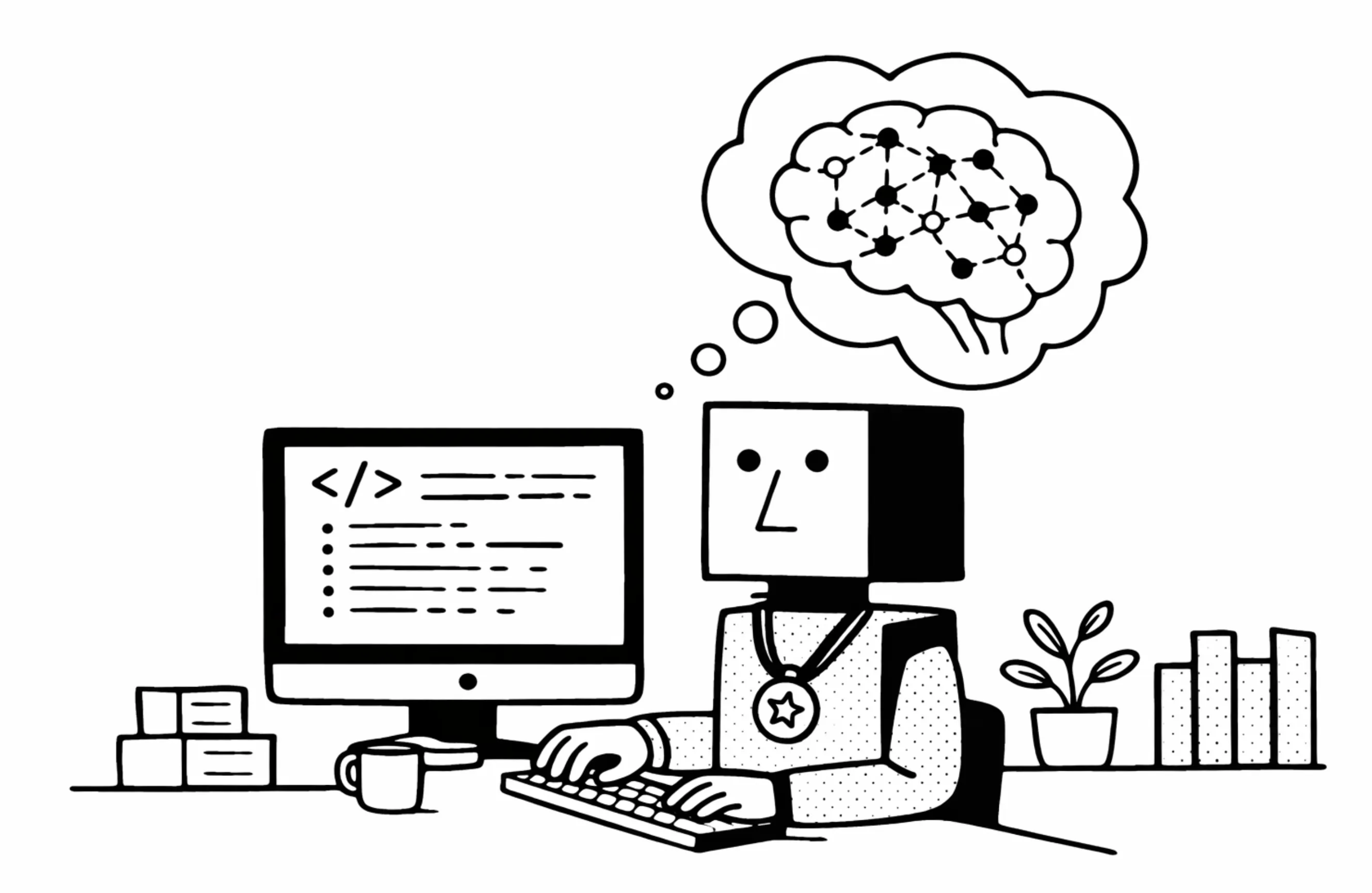
Most reasoning AI models work the same way: think first, then answer. You ask a question, the model works through it internally, then outputs a response.
That works fine for math problems. It’s a bad fit for writing code.
A new paper — Think-Anywhere — points out the obvious thing we’ve all been ignoring: code is hard in ways that only reveal themselves while you’re writing it. You don’t know the full complexity of a function until you’re halfway through implementing it. Forcing all the reasoning upfront is like asking a developer to plan every line before touching the keyboard.
What they built
Think-Anywhere lets an LLM invoke reasoning at any point during code generation — not just at the start. The model learns when to pause, think, and then continue, based on where things get genuinely hard.
They trained it in two stages:
- Cold-start training — teach the model to recognize reasoning patterns by imitation
- Reinforcement learning — let the model explore on its own when and where mid-generation thinking actually improves outcomes
The result: the model learns to pause at “high-entropy” positions — the moments of real uncertainty — rather than burning reasoning tokens on the parts it already knows.
Why this matters
Better code generation benchmarks are nice. But the deeper insight is about adaptive reasoning — the idea that intelligence isn’t just about thinking more, it’s about knowing when to think more.
This has implications beyond code. Any AI system that takes sequential actions — writing, planning, tool use, agent workflows — could benefit from the same principle. Don’t front-load all the reasoning. Distribute it where it’s actually needed.
For teams building AI-assisted development tools or code agents, this is a meaningful architecture shift. It’s the difference between a system that plans and executes, and one that plans, executes, notices a problem, thinks again, and continues.
The latter is much closer to how good engineers actually work.
Read the paper: arxiv.org/abs/2603.29957